
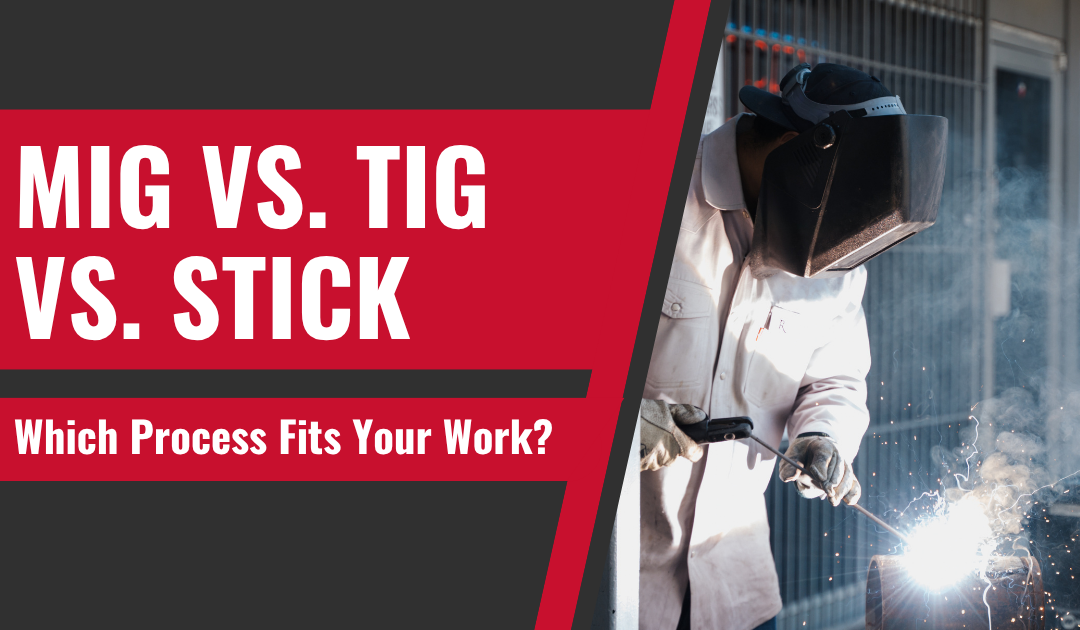
MIG vs. TIG vs. Stick: Which Process Fits Your Work?
If you walk into our shop on Bryan Avenue here in Fort Worth, one of the first things you will likely ask is which machine you actually need. Maybe you are a seasoned hand looking to upgrade your rig, or maybe you are just starting out in your garage. Either way, the “Big Three” processes (MIG, TIG, and Stick) each have a personality of their own.
Out here in North Texas, we do a bit of everything. We have guys working on massive cattle trailers, local artists doing custom furniture in the Design District, and industrial crews keeping our city infrastructure moving. Choosing the right process is not about which one is “better” in a general sense. It is about which one is going to make your specific job faster, cleaner, and more profitable.
MIG Welding: The Speed King
MIG welding is often the first thing people learn, and for good reason. It is fast, it is relatively easy to pick up, and it works great on a huge variety of thicknesses. If you are doing high volume work or you just want to get a project finished before the Texas sun gets too high in the sky, MIG is likely your best friend.
Think of MIG like a hot glue gun for metal. You have a spool of wire feeding through the gun, and as long as you have your settings dialed in, you just point and shoot. It is excellent for “point A to point B” welding where you have a lot of linear feet to cover. In our neck of the woods, we see a lot of automotive guys and general fabricators leaning on MIG because it handles thin sheets and medium plates with ease.
The downside? It does not love the wind. If you are trying to MIG weld outside on a breezy day in Arlington, your shielding gas is going to blow away, and you will end up with a porous, ugly mess. But for shop work, it is hard to beat for efficiency.
TIG Welding: The Surgeon’s Tool
Now, if you want to talk about “pretty” welds, you are talking about TIG. This is the process for the perfectionists. If you are working on high end stainless steel, aluminum, or chrome-moly, TIG is the way to go.
TIG is a two-handed operation. You have a torch in one hand and a filler rod in the other, and you are using a foot pedal to control the heat. It is a dance. Because of that, it takes a lot more practice to master than MIG. But the control you get is unmatched. You can put the heat exactly where you want it without throwing sparks or spatter all over the place.
We see a lot of aerospace guys and custom motorcycle builders coming into Tarrant Welding for TIG supplies. It is a slower process, but the results are clean enough to be a work of art. Just remember, TIG requires the metal to be surgical-grade clean. If you try to TIG weld through rust or mill scale, you are going to have a bad day.
Stick Welding: The Old Reliable
Stick welding is the grizzly veteran of the bunch. It is not pretty, it is not fast, and it is definitely not high-tech. But when the chips are down and the work is dirty, Stick is the one that gets the job done.
Out here on the ranch or on a windy construction site, Stick is king. It does not use a shielding gas tank, so you do not have to worry about the North Texas wind ruining your bead. It also has the highest “dig” of the three, meaning it can burn right through rust, paint, and grime that would stop a MIG or TIG machine dead in its tracks.
If you are repairing a heavy gate in a field or working on structural steel, Stick is the process you want. It is a bit messy and you will be chipping away slag once you are done, but the bond is incredibly strong. It is the ultimate “fix-it” tool for heavy duty equipment.
Breaking It Down: Which One Should You Buy?
To make it easy, let’s look at your typical day.
If your work mostly involves staying in the shop, building furniture, or doing light trailer repairs, go with MIG. It is the most versatile for a general shop environment.
If you are doing precision work, thin-gauge specialty metals, or you want your welds to look like a row of stacked dimes, invest in a TIG setup.
If you spend your time outdoors, working on heavy machinery, or dealing with thick, rusty steel, Stick is your go-to.
Why the Right Setup Matters
One mistake we see guys make is trying to force one machine to do everything. While there are “multi-process” machines that can handle all three, you still need to make sure you have the right accessories and gas for each.
At Tarrant Welding, we do not just sell you a box and wish you luck. We want to know what you are actually doing. Are you welding a 1/4 inch plate for a smoker? Are you fixing a cracked aluminum rim? Are you out in the field on an engine-drive unit? When you tell us the job, we can help you pick the wire, the rods, and the gas mixes that will actually work.
Making the Move
Upgrading your equipment is a big step for any business or serious hobbyist. We know that a top-tier Miller or Lincoln rig is an investment. That is why we offer straightforward financing options to help you get the machine you need today without draining your operating cash.
You can bundle your machine, your safety gear, and your first round of consumables all into one monthly payment. It is a simple way to make sure you have the right tool for the job from day one.
The Tarrant Difference
There is a lot of information online, but nothing beats talking to someone who has actually been in the booth. Our team in Fort Worth is here to give you the straight talk. We do not do fancy sales pitches or technical babble. We just give you the facts based on years of experience in the DFW welding community.
If you are ready to take your projects to the next level, come see us. We will help you dial in your specs, pick your kit, and get you back to work with a setup that is handcrafted, local, and done right.
Ready to get a quote on a new setup? Give us a call at 817-927-3331 or stop by the shop. We will get you squared away.